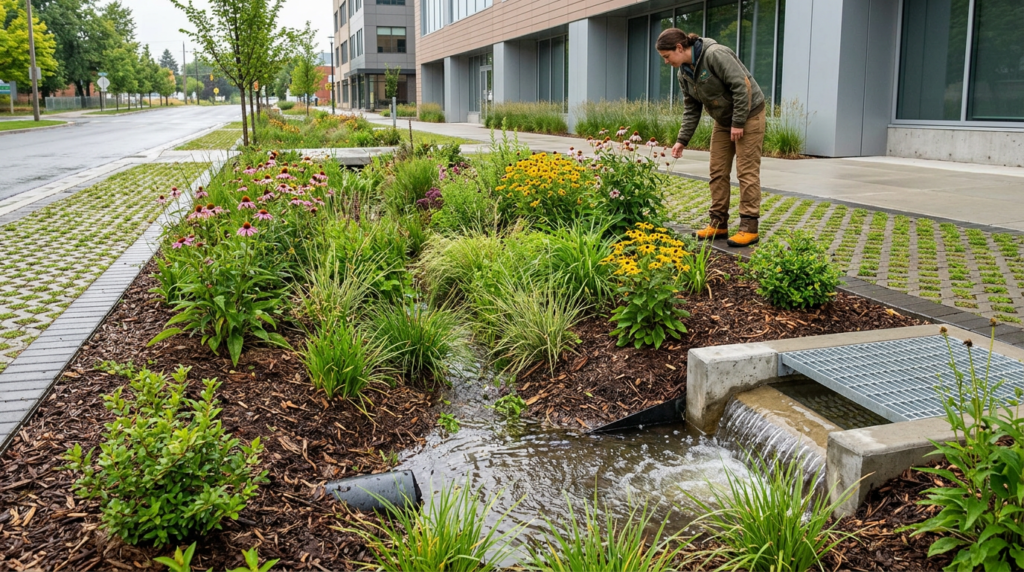
Quick answer: Stormwater management solutions are ways to capture, slow, clean, and safely release rainwater so it doesn’t flood your property or pollute nearby waterways. The right choice depends on your site’s slope, soil infiltration, available space, and local drainage rules. Common approaches include grading and swales, catch basins and underground piping, rain gardens and infiltration trenches, detention/retention basins, and permeable pavement.
What “Stormwater Management” Means On A Real Property
Stormwater is the runoff that happens when rain hits roofs, driveways, and compacted ground and can’t soak in fast enough. A good plan manages both the volume (how much water) and the rate (how quickly it moves), while also reducing sediment, oils, and nutrients that get carried along.
On most sites, practical stormwater management solutions combine a few tools: shaping the land so water flows where you want, adding structures to collect it, and using soil and vegetation to filter and infiltrate it. The goal is controlled drainage that protects foundations, pavement, neighbors’ yards, and downstream pipes and streams.
Quick symptom-to-solution map:
- Basement seepage near downspouts → downspout extensions, splash blocks, regrading along the foundation, and sometimes a footing drain assessment.
- Driveway or garage sheet flow → trench drain, catch basin, or regrading to a stable outlet.
- Persistent ponding that lasts more than ~48 hours → regrading to remove low spots, adding an underdrain, or shifting to a lined/controlled discharge option if soils won’t infiltrate.
- Erosion rills or a “new creek” after storms → stabilized swale/channel, check dams, slope protection, and slowing/spacing the flow.
- Overflowing gutters or roof water blasting landscaping → gutter fixes plus downspout routing to infiltration/storage or a solid pipe to an approved outlet.
If you’ve seen standing water after storms, erosion channels, soggy lawns, or water in the basement, those are signals the site’s runoff path is uncontrolled or undersized.
Common Options And What They’re Best At
Grading, swales, and berms redirect water on the surface. They’re often the first step because they’re simple and visible, but they need the right slopes so they don’t pond or erode.
Catch basins, area drains, and storm piping move water quickly to a safe outlet. They’re useful where space is tight, but they can shift problems downstream if the discharge point isn’t designed to handle the flow. They also require maintenance so inlets don’t clog with leaves and grit.
Infiltration practices (rain gardens, dry wells, infiltration trenches) soak water into the ground and improve water quality. They work best in soils that drain reasonably well and where groundwater and building setbacks allow. Poorly draining soils can turn these into perpetual puddles if not sized and detailed correctly.
Detention or retention basins store runoff. Detention holds water temporarily and releases it slowly; retention keeps a permanent pool. These are common for larger lots or developments and can be paired with forebays or vegetated edges to trap sediment.
Permeable pavement reduces runoff from parking and walkways by letting water pass through to a stone reservoir. It can be a great fit, but it needs proper subbase design and periodic vacuuming to prevent clogging.
How To Choose The Right Approach For Your Site
Start with how water moves today. Walk the property during a moderate rain if you can. Look for downspouts dumping next to the foundation, driveway runoff cutting across the lawn, or low spots that stay wet for more than a day or two.
Soil and groundwater conditions drive many decisions. At a concept stage, a common screening step is a small test pit or hand-auger hole to see soil layers and check for shallow groundwater, paired with an infiltration/percolation-style test (timing how fast water drops in a prepared hole). Faster drawdown generally supports rain gardens and infiltration trenches; very slow drawdown, tight clays, or water showing up shallow in the hole often pushes the design toward underdrains, lined features, surface conveyance, or detention with a controlled outlet. Site specifics and local standards can override these rules of thumb.
Local requirements matter too. Many towns require managing the “first flush” of runoff for water quality, limiting peak discharge rates, or providing a specific storage volume for new impervious area. Designing to those standards early prevents expensive redesigns after review comments.
When To Call An Engineer Vs. A Landscaper Or Contractor
A good landscaper or drainage contractor can often handle straightforward fixes like extending downspouts, regrading small areas, adding a dry creek bed for shallow flow, or installing a basic catch basin tied into an existing approved outlet.
Call an engineer when any of these are in play: water is affecting a neighbor’s property, you’re proposing a new discharge point or piping to the street, runoff may reach a wetland/stream/ditch, slopes are steep enough that erosion or slope stability is a concern, you’re adding a meaningful amount of new impervious area (new driveway, addition, parking), or the town is asking for calculations, stamped plans, or a formal stormwater report. Those situations benefit from a documented design, defined overflow routes, and a plan that matches permitting expectations.
If you want help, gather a few basics first: photos or short videos during/after storms, a simple sketch showing drainage paths and low spots, downspout and sump pump discharge locations, any prior site/civil plans you have, and any municipal notes or checklist items you’ve been given. With that in hand, Haughawout Engineering & Markets is the place to get help.