Quick answer: A safe long-distance medical transport service should start with a fit-for-transport screening, then match the trip to the patient’s acuity (ambulatory, wheelchair, stretcher, oxygen-dependent, or higher-acuity). The vehicle should use proper securement and transfer methods, follow infection-control steps, and plan routes for weather and delays. During the trip, staff should do condition checks at appropriate intervals and have clear thresholds for stopping, calling 911, or diverting to an emergency department.
Core Safety Practices That Protect Patients on the Road
Long-distance medical trips are less about speed and more about predictable, controlled care. Solid medical transport safety protocols usually begin before anyone leaves the driveway: confirming the passenger’s current condition, mobility limits, fall risk, oxygen needs, and what “red flag” symptoms require stopping or escalating care.
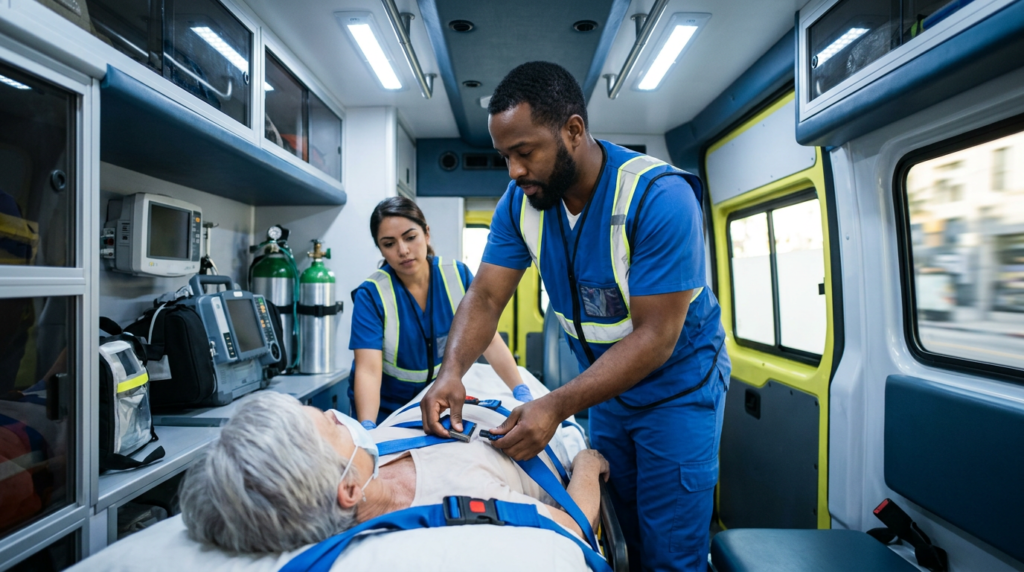
Inside the vehicle, safety basics matter more than people expect. A stretcher or wheelchair should be properly secured to the floor lock system, with the passenger restrained correctly (not just “buckled somewhere”). Staff should use safe transfer techniques and equipment (gait belts, slide boards, or lift assistance when appropriate) to reduce patient falls and caregiver injuries. A clean, uncluttered patient area reduces trip hazards and keeps supplies within reach.
Communication is also a safety protocol. The driver and attendant should agree on how to call for a stop, how to handle sudden nausea or pain, and what to do if the patient’s condition changes. Simple, rehearsed cues beat improvising on a highway shoulder.
Match Safety Protocols to Patient Acuity
Not every “medical transport” trip needs the same safeguards. A good dispatch intake separates the ride type by acuity and then assigns the right vehicle, staffing, and equipment.
Typical: Ambulatory or wheelchair passengers who are medically stable usually need safe transfers, proper wheelchair securement, seatbelts, assistance with steps/ramps, and planned rest breaks. Sometimes available: Extra physical assistance for transfers, help managing personal items, or coordination for facility pickup/drop-off windows. Requires a higher level of care: Chest pain, new confusion, uncontrolled bleeding, repeated fainting, or any condition that could deteriorate quickly.
Typical: Stretcher transport for patients who cannot sit upright generally adds a secured stretcher mount, safe loading/unloading, pressure/discomfort checks, and positioning support. Sometimes available: Basic monitoring during the ride if the provider is equipped and staffed for it. Requires a higher level of care: Unstable vital signs, active respiratory distress, or a need for continuous clinical interventions beyond what non-emergency transport can provide.
Typical: Oxygen-dependent passengers who are stable on a set flow rate often need verified settings, secured cylinders, and a plan for delays. Sometimes available: Pulse oximetry checks if the situation calls for it and the provider can do it appropriately. Requires a higher level of care: Increasing oxygen needs, inability to maintain oxygenation at prescribed settings, or frequent suctioning/airway concerns—these are signs to request a higher-acuity transport option.
Higher-acuity: If the patient needs continuous monitoring, IV medications, frequent vital sign reassessments, or rapid escalation capability, that usually points to an ALS/BLS ambulance level rather than a standard long-distance medical transport.
Vehicle, Equipment, and Oxygen Handling Standards
A long-distance medical transport vehicle should be maintained like a safety-critical system. Reliable brakes, tires, lighting, climate control, and secure mounting points for medical equipment reduce preventable incidents. Patients can worsen if they get too hot, too cold, or too jostled, so a smooth ride and stable temperature are not “comfort extras.”
Equipment and monitoring should be matched to the patient’s needs, not assumed. If the passenger has a history of low oxygen levels, recent respiratory illness, or needs continuous oxygen, confirm the provider can check oxygenation as needed (for example, with pulse oximetry) and has staff qualified to respond if readings or symptoms worsen. If the patient has recently had unstable blood pressure, fainting, new weakness, or medication changes, ask what reassessments are planned and what triggers escalation.
For oxygen, safer handling includes confirming the prescribed flow rate, ensuring cylinders are secured upright, checking remaining pressure before departure, and carrying enough supply for the full trip plus extra for traffic or weather delays. Oxygen should never be stored loose where it can become a projectile in a sudden stop.
Pre-Trip Checklist and When to Escalate
Use this practical checklist before booking or departing. It helps you and the transport provider get on the same page.
- Confirm the patient’s current baseline: alertness, breathing, pain level, and mobility.
- List diagnoses and recent changes (new symptoms, recent hospitalization, medication changes).
- Clarify ride type needed: ambulatory, wheelchair, stretcher, oxygen-dependent, or higher-acuity.
- Verify pickup/drop-off details: exact addresses, stairs/ramps, elevator access, and who will receive the patient.
- Ask what securement will be used for wheelchair/stretcher and what transfer assistance is available.
- If oxygen is used: confirm flow rate, delivery method, cylinder duration, and the plan for delays.
- Pack essentials in a reachable bag: meds list, ID/insurance card, discharge papers, snacks/water if allowed, continence supplies, phone charger.
- Discuss comfort and safety needs: positioning, pressure relief, nausea history, anxiety triggers, and planned stops.
- Agree on communication: who gets updates, and how to report symptoms during the ride.
Clear thresholds reduce hesitation in a crisis. Call 911 immediately (or have the crew do so) for severe trouble breathing, blue/gray lips, unresponsiveness, new severe chest pain, signs of stroke (face droop, arm weakness, speech trouble), uncontrolled bleeding, repeated fainting, or a seizure that doesn’t stop quickly. Divert to the nearest emergency department if symptoms are worsening and not quickly resolving—examples include escalating shortness of breath despite prescribed oxygen, persistent vomiting with weakness, new confusion/agitation, a suspected fall injury, or pain that becomes severe and atypical for the patient.
After any escalation, request that the receiving team gets a brief summary of what changed, what the patient reported, and any oxygen settings used during transport.
For help arranging long-distance medical transport, contact Managed Medical Transport, Inc.